How do Hearth and Hamlet policies work?
Hearth and Hamlet policies let you set taxes, provide welfare, protect citizens, and shape how the kingdom operates. These choices are not separate from production: happiness provides an economic bonus, so a policy that earns more Gold can still weaken the wider settlement if its morale cost is too high.
That creates a three-way trade-off:
- Revenue and resources: taxes and economic rules can support expansion.
- Resident wellbeing: welfare and kingdom conditions affect happiness.
- Security: protection and raid readiness consume resources that could otherwise fund growth.
The exact numerical relationship between each policy and happiness has not been released. This wiki therefore explains the confirmed structure without publishing invented percentages.
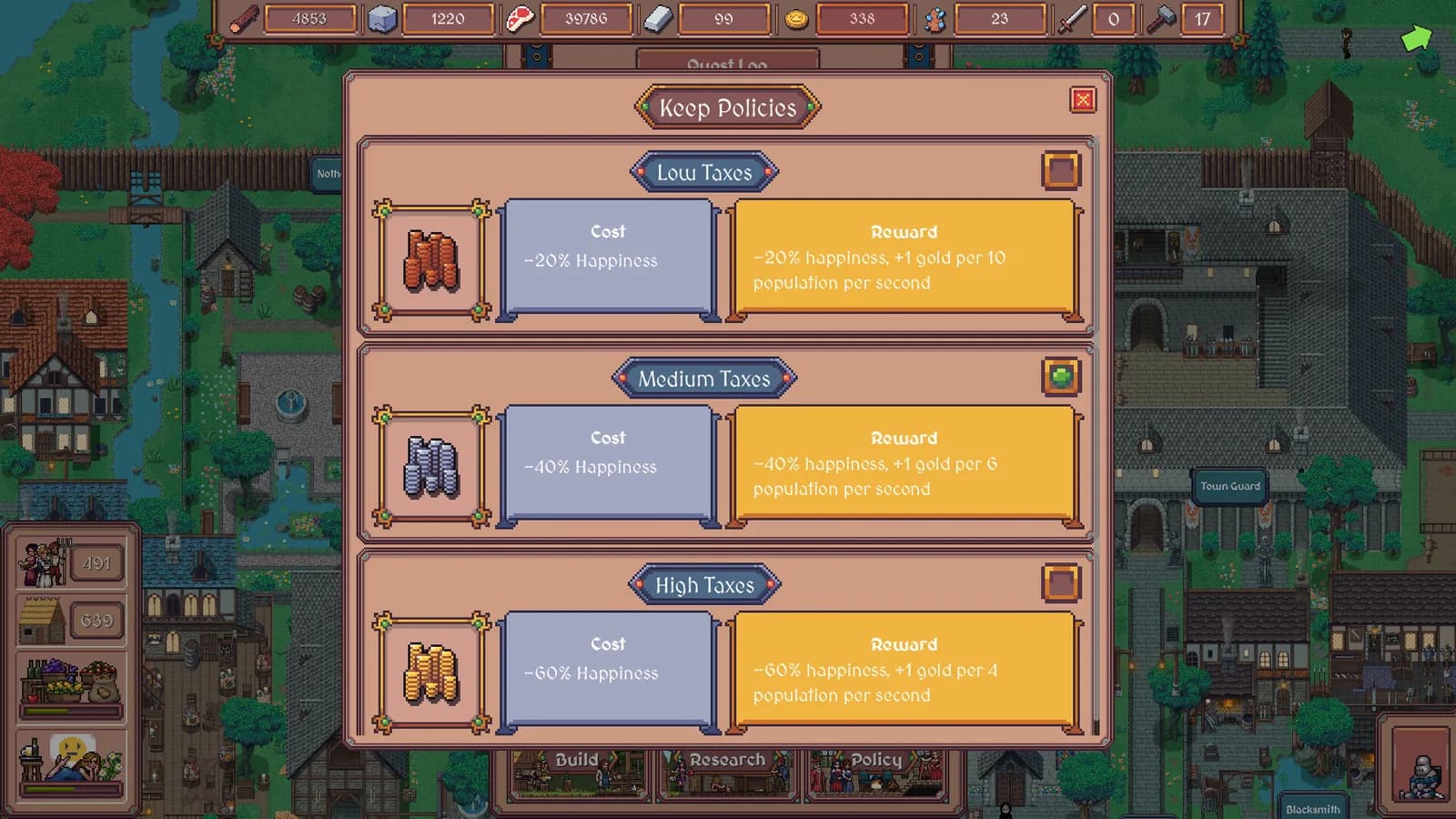
Read policy effects in context
A policy is not good or bad in isolation. A production bonus may be valuable only if enough workers are assigned to the affected jobs. Higher income may not compensate for a happiness loss if the resulting production slowdown hits every critical resource. A welfare expense may be easier to carry after trade and Gold income are stable.
Before changing a rule, note the current Food direction, available workers, Gold balance, happiness, and any approaching defense cost. Change one major condition at a time, then observe the new trend. Multiple simultaneous policy and worker changes make it difficult to understand which one solved—or caused—the problem.
A safe policy-change checklist
- Record whether Food, Gold, and happiness are rising or falling.
- Check which workers and resources are committed to the next required step.
- Read both the policy cost and reward; do not evaluate only the Gold side.
- Change one policy tier or category.
- Let the new production trend become visible before adjusting workers as well.
Policy names, unlock requirements, happiness thresholds, duration, and reversibility may differ at launch. The reliable principle is that population, economy, and defense form one system: governing choices can change how efficiently the resource and worker layers operate.