Why this is a framework, not a stopwatch
The Demo's pace depends on how actively you gather, when you move workers, which research appears, and how long you observe the settlement between purchases. A guide that promises exact minute marks would confuse speed with reliability—and could become wrong when the full game launches.
Use these phases in order, moving forward when the kingdom is stable rather than when a timer says so.
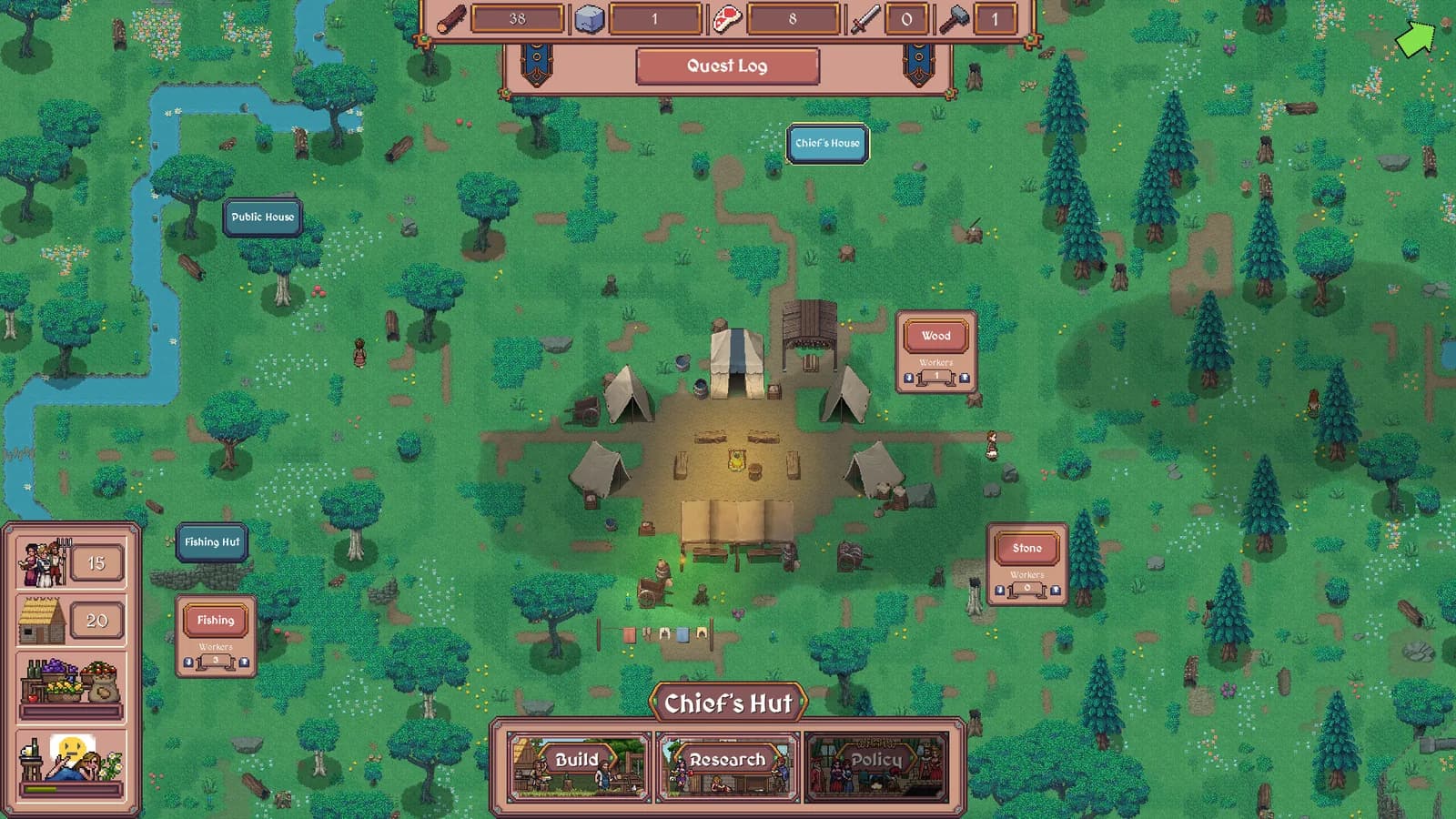
Phase 1: establish automated production
Complete the opening prompts and gather the resources required to create the first useful jobs and buildings. Manual clicks bridge the opening gap; workers are the scalable solution. Keep assignments broad enough that one construction cost does not leave every other resource at zero.
Phase 2: make Food boring
Food should rise or remain comfortably stable before you accelerate population-dependent expansion. If it falls, pause the next optional project and move a small number of workers toward Food. Wait long enough to see the new direction. Do not assume a current stockpile is safe merely because it looks large.
Phase 3: remove the active bottleneck
Check what the next meaningful upgrade, building, or research requires. Increase that resource without abandoning Food. If storage is capped, spend or improve capacity before adding more workers to the capped resource.
Phase 4: choose permanent progress deliberately
Research can unlock advanced buildings, policies, magic, and upgrades. Select a benefit that supports the problem your kingdom actually has. A production technology for an abundant resource may be less useful than capacity, Food stability, or an unlock that advances the main progression path.
Phase 5: create a defense margin
As raid systems appear, reserve enough production and workers to respond. Do not start a luxury upgrade that consumes the exact resource needed for defenders. Your goal by the end of the first session is not maximum visible expansion; it is a kingdom that can continue growing without a Food spiral or emergency reallocation.
Progress checkpoints
Move to the next phase when the answer in the right column is “yes.”
| Checkpoint | Ready when… |
|---|---|
| Automated production | Workers, not manual clicks, supply the resources used repeatedly. |
| Food stability | Food remains positive after the latest population or worker change. |
| Useful spending | The next purchase removes a capacity, production, unlock, or defense constraint. |
| Research timing | The selected permanent benefit helps the current plan and can be afforded without breaking it. |
| Defense margin | A required defensive step can be paid for without emptying Food or halting all production. |
For moment-to-moment decisions, keep the Resources reference and Worker Allocation Guide nearby.